
Greek Sicily: a journey through temples, theatres and myths on the island of the Hellenes
 Sicily is a mosaic of civilizations. Phoenicians, Arabs, Normans, Spaniards: all left their mark, but it is the Greek world that has impressed on the island one of its most imposing and fascinating legacies. You don’t need to be an archaeologist to feel moved in front of a perfectly preserved Doric temple, or to get chills while whispering on the stage of a theatre built 2,500 years ago. You simply need to let yourself be guided along an itinerary that intertwines ancient stones, spectacular landscapes and stories that have travelled through millennia. Here is an ideal route – a thematic journey – to discover Greek Sicily by following the footprints of the ancients, in seven stops that tell the past but speak directly to the heart.
Fasten your seatbelts, we’re taking off! Where to? On an itinerary through Greek Sicily, among Doric temples overlooking the sea, theatres carved into the rock and ancient cities founded by Hellenic settlers. An emotional journey through suspended landscapes, timeless myths and testimonies that still speak of the power, spirituality and worldview of the Greeks in Sicily. Sicilian Secrets is your gateway to wonder!
Stop 1 – Naxos, the first colony: where it all began
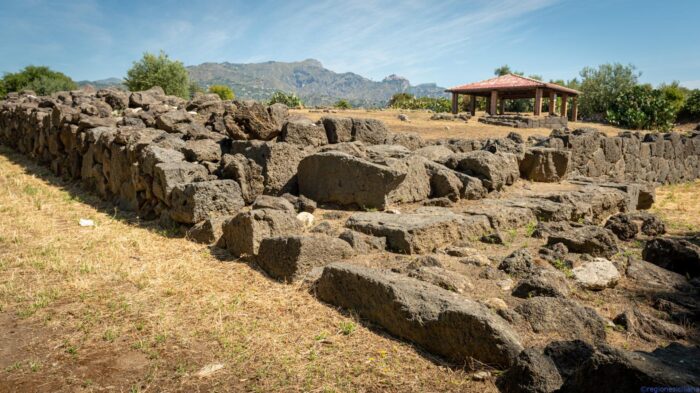
Greek history in Sicily begins here: Naxos, founded in 734 BC by Chalcidian settlers. Today the ancient city no longer exists, but the Archaeological Park of Naxos preserves the remains of walls, dwellings and a sanctuary likely dedicated to Aphrodite. It’s a place that doesn’t overwhelm with grandeur, but captivates with its suspended atmosphere: sea, light, ancient stones and the scent of citrus gardens. Here is a fascinating curiosity: it was from Naxos that the urban model later adopted by many Siceliot cities spread, featuring orthogonal streets and functional districts. A remarkably advanced form of “urban planning” born from Greek ingenuity. From here, the settlers headed south and west, giving life to a whole archipelago of poleis that would shape Mediterranean history.
Stop 2 – Syracuse: the Mediterranean powerhouse
Few places in the world can narrate the splendour of Greek Sicily like Syracuse, founded in 733 BC by Archias of Corinth. For centuries it was a powerful, wealthy city, celebrated by Cicero as “the greatest and most beautiful of all Greek cities”.
Unmissable highlights in Greek Sicily:
• The Greek Theatre
Perfectly oriented towards the sun and carved into the rock of the Temenite hill, it is one of the largest ancient Greek theatres in existence. To watch a classical play here at sunset is to feel history come alive beneath your feet.
• The Ear of Dionysius
An artificial cave with extraordinary acoustics: according to tradition, the tyrant Dionysius used it to eavesdrop on prisoners. Legend? Probably. But the magic and mystery remain intact.
• The Altar of Hiero II
A colossal ceremonial altar, 200 metres long, unique in its kind: even without standing structures, its sheer scale is awe-inspiring.
• Ortygia and the Temple of Apollo
The oldest Doric temple in the Western world stands right here, in the heart of Syracuse’s old town: a symbol of the city’s incredible historical layering.
And if you want a true journey into the Greek mind, Syracuse is also the city of Archimedes, the genius who revolutionised physics and mathematics.

Stop 3 – Akrai and the theatre suspended on the hills
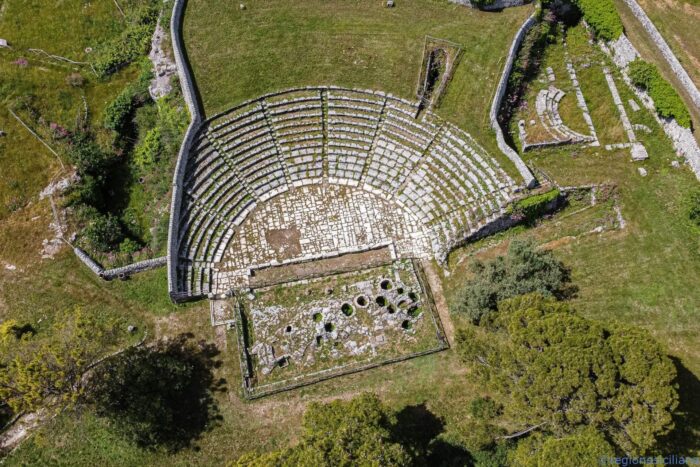
Near Palazzolo Acreide lies Akrai, a colony founded by the Syracusans in 664 BC. Less famous than other sites, it’s a precious stop for those seeking authenticity. Here, the Greek theatre is intimate and delicate, carved into pale stone. It doesn’t have the monumentality of Syracuse or Taormina, but it offers something different: the enchantment of silence. Looking at it, you can easily imagine the inhabitants of Akrai watching Menander’s comedies as the hills turned golden at sunset. Next to the theatre lie a rock-cut necropolis and the enigmatic “Santoni”, a complex of votive reliefs dedicated to chthonic deities, unique in the Siceliot world.
Stop 4 – Agrigento and the Valley of the Temples: the supreme beauty of Greek Sicily
If there is a place capable of embodying Greek harmony, it is the Valley of the Temples. Founded by Rhodian-Cretan settlers in the 6th century BC, ancient Akragas was described by the poet Pindar as “the most beautiful city of mortals”.
Today, the beauty of this corner of Greek Sicily remains untouched.
Highlights not to miss:
-
Temple of Concordia – one of the best-preserved Doric temples in the world.
-
Temple of Hera Lacinia (Juno) – overlooking the coast, offering breathtaking sunsets.
-
Temple of Heracles – the oldest, still imposing.
-
Temple of Olympian Zeus – gigantic, even in ruins, with the remains of its colossal telamons.
Walking among these giants means stepping into the Greek idea of perfection: rigour, proportion, balance. And it’s impossible not to feel moved when the warm sea wind slips between the columns. Here is a curiosity: these temples were not “white”. Originally, they were colourful, vividly decorated with pigments that have long since disappeared.

Stop 5 – Selinunte: the western frontier
If Agrigento represents absolute beauty, Selinunte is pure grandeur. Founded in 628 BC, it was one of the westernmost Greek colonies in Sicily and often clashed with nearby Carthage. Today, its archaeological park is one of the largest in Europe. Temple E (most likely dedicated to Hera) has been partially reconstructed and is truly impressive, Temple F reveals its construction phases; and the immense Temple G was meant to be one of the largest ever built in the Greek world. Selinunte also offers a unique landscape: dunes, sea, cliffs. This blend of wild nature and colossal ruins creates a deeply evocative, almost epic atmosphere.

Stop 6 – Segesta: the solitary temple in nature
Segesta was not a Greek city in the strict sense: it was Elymian, though it adopted Greek architectural models. Its Doric Temple (5th century BC) is among the most photographed on the island, perfectly harmonious despite never having been completed. Nearby, atop Mount Barbaro, stands the theatre, offering a spectacular view of the Gulf of Castellammare. Here, summer performances deliver emotions that stay with you for years. A compelling curiosity: the temple bears no trace of worship – no cella, no interior decorations. Scholars still debate: was it left unfinished? Or was it conceived as a symbolic monument?

Stop 7 – Taormina: the most scenic theatre in the world
We return to the Ionian coast. Greek Taormina is a marvel where art and landscape merge without boundaries. Its Ancient Theatre – dating back to the 3rd century BC – is considered one of the most scenic on the planet, with Mount Etna rising majestically in the background. The Romans expanded it, but the original structure remains Greek, especially in the choice of the location: an architecture born from nature, not imposed on it. Every concert, opera or performance here becomes an unforgettable moment, a dialogue between humanity, history and landscape.

