
Disappearing Sicilian crafts: stories, hands and knowledge not to be lost

There are sounds in Sicily that are heard less and less today. The sharp strike of a hammer on an anvil, the soft rustle of a loom, the creak of wood taking shape under skilled hands. These are the sounds of disappearing Sicilian crafts: ancient trades that for centuries shaped the island’s everyday life and that today risk becoming nothing more than a memory, suitable for black-and-white photographs or grandparents’ stories. And yet, behind those silent workshops and forgotten professions lies the most authentic soul of Sicily: a form of knowledge built on patience, observation and slow time, resisting modernity and continuing to tell us who we were and, perhaps, who we could still become.
There are crafts that make no noise when they disappear. They do not close with an announcement, they leave no darkened signs or press releases behind. One day, they are simply gone. In Sicily, this happens often: workshops pulling down their shutters, skilled hands laying down their tools, knowledge handed down for centuries at risk of being lost in silence. Talking about disappearing Sicilian crafts is not about indulging in nostalgia, but about questioning what truly makes this land unique. Because Sicily is not only landscapes, sea and archaeology: it is also a human heritage made of gestures, rituals and skills that tell a way of living time, work and community.
The carradore: the craftsman of travel
Once, he was a central figure in every town. The carradore built and repaired carts, wheels and axles: without him, agricultural life would come to a halt. The Sicilian cart was not just a means of transport, but a cultural manifesto, decorated with epic scenes, vivid colours, religious and popular symbols. Today, the carradore survives in only a handful of workshops, more as a guardian of memory than as an economically sustainable profession. Wheels are no longer needed, but knowledge still is: the knowledge of those who understand wood, balance of form, and the symbolism of a visual language that once spoke to everyone.

The puparo: theatre of wood and soul
The Opera dei Pupi (Puppet Opera) is a UNESCO heritage, yet pupari are becoming increasingly rare. Not because interest is lacking, but because generational turnover is. Being a puparo means carving, painting, operating and storytelling. It is a total craft, requiring years of apprenticeship and a level of dedication that few can afford today. Sicilian pupari did not merely stage Orlando and Rinaldo: they narrated values, conflict, justice and betrayal. They were, ultimately, the popular storytellers of a society that learned by watching and listening. Without them, we lose a collective way of telling our own story.

The salinaro: guardian of a fragile balance
In the coastal salt pans, especially between Trapani and Marsala, the salinaro worked in rhythm with the sun, the wind and the water. No rush, no force: only the art of waiting for the right moment. Today, many salt pans have been turned into museums or entrusted to industrial production. The traditional role of the salinaro survives thanks to just a few workers who still know the secrets of natural crystallisation. It is one of those disappearing Sicilian crafts because it is incompatible with modern ideas of productivity, yet perfectly aligned with slow and conscious tourism.

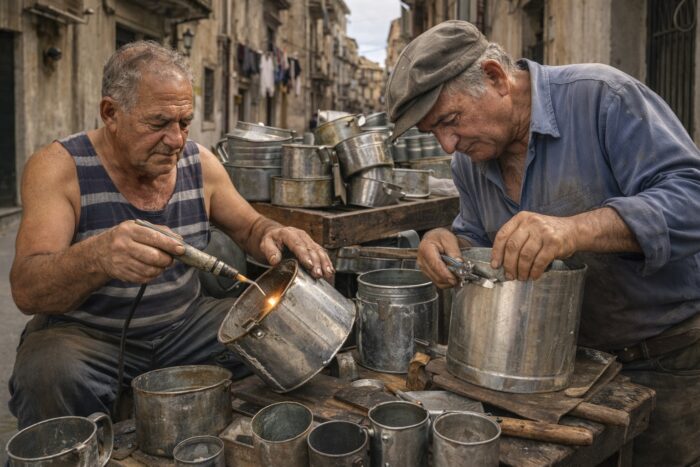
The tinsmith and the tinker: repairing instead of throwing away
There were men who moved through neighbourhoods repairing containers, pots and household items. The tinker gave objects a second life; the tinsmith created them. In a world without plastic and disposable goods, they were essential figures. Their disappearance is not only economic, but cultural. Because with them vanishes the idea that things should be repaired, not replaced. A concept more relevant than ever today, yet at risk of remaining nothing more than a slogan.
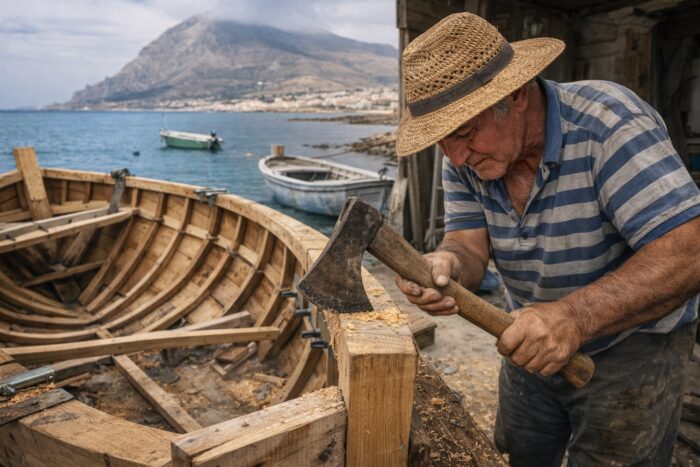
The master shipwright: geometry and sea among the disappearing Sicilian crafts
In small Sicilian shipyards, the master shipwright built boats “by eye”, without written plans. Measurements lived in the mind and in the hands. Each vessel was unique, designed for a specific sea, a specific fisherman, a specific type of fishing. With standardisation and fibreglass, this craft is becoming extremely rare. And yet it remains one of the most fascinating examples of applied artisanal intelligence, a form of knowledge combining empirical mathematics, experience and a deep understanding of the sea.
Embroiderers and weavers: the slow time of hands
In many inland Sicilian towns, embroidery and weaving were not hobbies, but real jobs. Dowries, sacred vestments, household textiles: everything passed through patient hands and trained eyes. Today, only a few elderly custodians of this knowledge remain, often invisible. And yet the value of their work is immense, especially in an era rediscovering authentic craftsmanship and the “handmade” as a political act even before an aesthetic one.

