
Giuseppe Di Giorgio: Sicilian roots, independent cinema, and the human gaze of “Sotto le stelle di Roma”
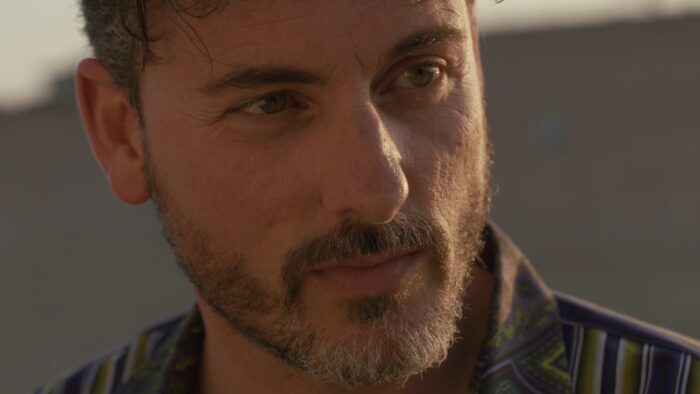 Giuseppe Di Giorgio is an actor, director, screenwriter, and film producer, one of the most recognizable voices in contemporary Italian independent cinema. Born in 1979 in Cerda (Palermo) and Pavian by adoption, he boasts over twenty years of experience spanning cinema, theatre, fashion, and television. Trained in Rome and Milan at theatre schools and academies, he developed a strong authorial identity from the outset, establishing himself both as a performer and as a writer-director. His cinema focuses on the human being, on moral choices and their consequences, offering a direct and realistic point of view on individual and social fragilities. Over the course of his career, he has signed numerous films as director, lead actor, and producer, earning more than 120 awards at national and international festivals. Some of his works have been selected for the David di Donatello Awards, and all are distributed on major platforms, with sales also abroad. In 2023, together with Elena Rivaldo, he founded Upgrade Film Production S.R.L., an independent film production company oriented toward narrative quality and artistic research. He is currently engaged in developing new feature films and a television series, continuing a coherent path between auteur cinema, independent production, and an international outlook. Sicilian Secrets interviewed him.
Q: How did your love for cinema begin, and what were the first steps that led you to become a director and actor?
A: My love for this field was born primarily thanks to the films of Franco and Ciccio. I remember perfectly when my father, back in 1984 – I was only five years old – screened inside our photographic studio in Cerda the first film by the Franchi–Ingrassia duo, I due toreri. From that moment on, I began to love not only them deeply, but cinema above all, despite my young age. To talk about when I began to seriously think about doing this job, we need to move to the late 1990s. At that time, I was working in the fashion industry as a model and was chosen by director Giorgio Capitani for a small role in the RAI series Commesse, alongside actor Franco Castellano. From then on, the desire to act grew stronger and stronger.
With great effort and numerous sacrifices, I made it to 2014 with various experiences behind me, but without ever having obtained major or leading roles. To access certain spaces, in fact, it was often necessary to frequent specific circles, know certain people, and accept compromises that did not feel like mine. For this reason, in 2015, I decided to direct my first film, without great expectations and completely no-budget, entitled La giusta scelta. A title that perfectly represented the decision I had made: to embark on a clean, merit-based path consistent with my values. Today, thanks to God, my tenacity, my studies, and constant perseverance, I have made six films and a short film. In addition, I founded a film production company together with Elena Rivaldo, Upgrade Film Production S.R.L., with which I continue to work and grow, looking together toward a better future.

Q: You have Sicilian origins (born in Cerda) but are “Pavian by adoption”: how have these two cultural worlds influenced your artistic vision?
A: There has been no external influence of any kind. I lived in Sicily until I was 15, then moved to Milan, then to Rome, Bologna, Parma, Monza: I traveled a lot, and this allowed me to come into contact with different realities, cultures, and mindsets. I am a person who adapts easily to any context, and I believe that this very ability to adapt has been one of my greatest resources. Certainly, Northern Italy gave me the opportunity to best express my personal and professional needs, leaving me internally free to choose, without constraints.
By contrast, during my youth – especially in the environment where I grew up – a discouraging mentality was very widespread, made up of phrases like: “Where do you think you’re going?”, “Who do you think will ever consider you?”, “You, an actor? Come on”. Support was scarce, while demoralization was frequent. I don’t know whether it was envy or simply fear of change, but very few truly believed in me. For this reason, I believe that freedom of expression has been my greatest source of personal enrichment and responsibility. It is precisely thanks to that freedom that I was able to build my path with awareness, determination, and respect for myself.
Q: The Sicily you carry with you, even when working far from the island, how does it continue to influence your gaze, your way of telling characters and stories?
A: In every one of my works, whether as a director, actor, or screenwriter, my Sicilian soul is always present. I believe that those who are born and raised in the South carry with them a particular depth, made of hardships and a complex mentality, but also of a strong desire to act and to build something more in their lives, even while having to confront territorial limitations that we all know. Giuseppe Di Giorgio is present in every character I create, because I am convinced that every performance, to be authentic and truly successful, must have a visceral connection with oneself. Only in this way can a character become real, credible, alive. This is my personal feeling, my artistic choice. To others, rightly, I leave free will.

Q: What is the most vivid memory from your childhood connected to acting or cinema, perhaps a film or a director, that shaped you?
A: Cinema Paradiso literally won me over. It was the first film capable of truly moving me and making me dream. That child who loved to take refuge in the projection booth, who had to break the rules every time to carve out small spaces of freedom, who endured the impositions of a mother opposed to cinema, represented for me – almost specularly – the path of my own life. In that story, I saw myself again: the effort, the prohibitions, the stubborn desire to pursue a dream despite everything.
And the ending of the film, that deeply moving sequence in which the protagonist revisits the fragments of film that the projectionist had kept for him and receives only after his death, marked me in my heart and soul. It is a scene that encapsulates memory, sacrifice, love, and the passing of the torch. And it was probably there that I understood, even if unconsciously, how cinema could become an integral part of my life.
Q: Sotto le stelle di Roma (Under the Stars of Rome) is based on a novel by Massimo Benenato: how did you encounter the book, and what was the spark that led you to adapt it for the big screen?
A: I had always wanted to meet the sons of Franco and Ciccio, especially after the passing of Franco Franchi. I followed Massimo, Franco’s son, on social media, and in 2020, during the height of the Covid period – despite it was summer – while returning from vacation and having to stop in Rome for a couple of days, I decided to write to him to propose a meeting.
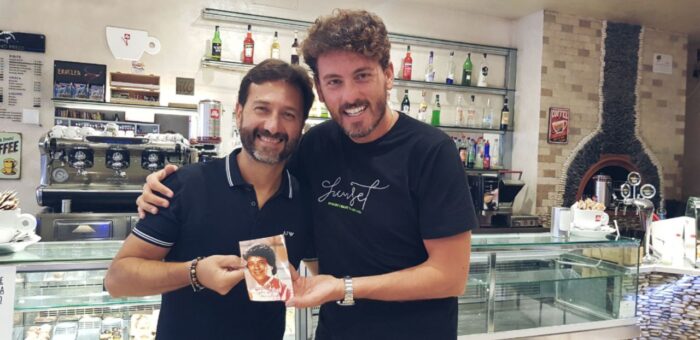
He accepted. We met at the bar of the Santa Maria delle Mole station, at the foot of the Castelli Romani. It was a simple but deeply meaningful moment. Massimo gave me an unpublished photograph of his father, a gesture that deeply moved me. Talking about artistic work, he told me he was writing a new novel and had just published one, Sotto le stelle di Roma (Under the Stars of Rome). We said goodbye with the promise to stay in touch.
Q: And then? How did the meeting between Giuseppe Di Giorgio and Massimo Benenato continue?
A: On my next trip to Rome, I asked him to bring me the book, which he handed to me autographed. On that occasion, Massimo arrived with another gift to which I am deeply attached: a tie that had belonged to his father, still stained with sauce. An object I keep like a relic, for the emotional and symbolic value it represents. Looking at the cover and reading the novel in one sitting, I came to the decision to propose a cinematic adaptation of the work.
The desire driving me was strong and sincere: to bring back to life, albeit through artistic fiction, the memory and spirit of Franco and Ciccio. At first, I had also thought of involving Giampiero Ingrassia, Ciccio’s son, imagining a project that could ideally unite the sons of the two great artists: a film based on Massimo’s novel, starring Giampiero. With enthusiasm and love, the idea of the film was born, which I managed to complete in less than two years. The only sour note was Giampiero Ingrassia’s non-participation, who, after careful consideration, decided not to accept a role in the project. A decision I respected, albeit with regret.
Q: This is the first film bearing the signature of Giuseppe Di Giorgio shot outside Pavia: what was the challenge of working in Rome in terms of timing, spaces, and production compared to previous experiences?
A: In reality, in 2021 I had already shot half of the film Finalmente libera in Abruzzo, but this project, being my first film entirely set in Rome, was completely different. Breathing in the atmosphere of cinema in Rome was a beautiful, intense, unique experience. Different in management, spaces, and timing: a different rhythm, a different energy. Moving around Rome is not easy at all, especially compared to the sets I had previously managed in Milan, Pavia, Alessandria, Lodi, and other northern cities. Rome is the capital, and above all, the capital of cinema. It has a charm and a beauty that, in my opinion, are unmatched. I am profoundly happy to have made this film in the Eternal City, and I truly hope to be able to shoot others there. Who knows, maybe very soon.
Q: In the film you address themes such as family, friendship, love, and homosexuality: what message do you hope will resonate most with the audience?
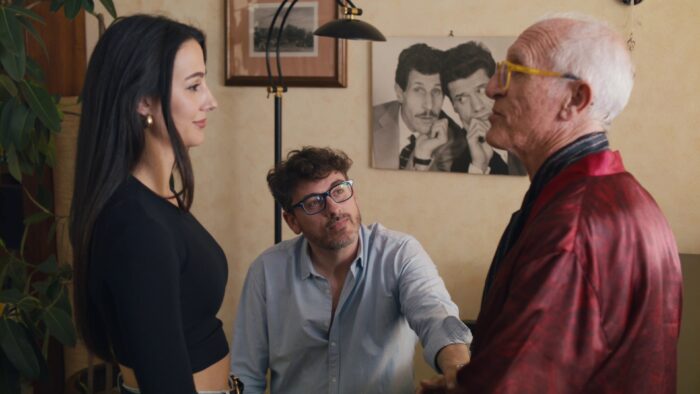
A: In every theme I address, the essence of life is present. I do not believe in a single or imposed message: I have no preferences or filters. I write, perform, and direct with the conviction – and the hope – that all messages can coexist within my films. Love is universal and belongs equally to each of us. Homosexuality is respect for others’ choices and lives. Family is sacred, fundamental, I would say indispensable. Friendship is fundamental. Together, these elements make up life: one life, earthly, real, direct, intense.
Q: You are a director, screenwriter, actor, and editor: how do you manage all these responsibilities on set, and what gives you the greatest personal satisfaction?
A: I am fully aware that, in many of my projects, I have had to take on multiple important roles. This choice, on the one hand, allowed me to maintain a high level of quality control over the work; on the other hand, it inevitably involved some limitations. It was never about selfishness or protagonism, but about a necessity linked to the available budget. It is true: I have gained experience in different areas of film production and today I am able to manage them competently, as demonstrated by the results achieved. However, it is equally true that a more structured budget would allow each role to be entrusted to dedicated professionals, further improving the overall quality of the project. This would allow me to focus fully on what gives me the greatest satisfaction and for which I feel I have a natural predisposition: directing and acting.

Q: Looking to the future, what projects or cinematic ambitions do you have after Under the Stars of Rome? Is there something radically different you would like to experiment with?
A: I currently have several projects in the pipeline: two films and a television series. The goal is to be able to launch at least one of them within this year. They are three projects completely different from one another, both in themes and settings, and this very diversity represents a great source of creative stimulation for me. We are working intensely on development and hope to be able to start the first castings for the new project by next summer.
I love experimenting with everything that concerns communication and art. Cinema, with its poetic and narrative power, allows me to do so on tiptoe, without invading or trampling on anyone, but always seeking a sincere dialogue with the audience. What I truly feel I desire today, something radically different from the past, is to be directed by a director able to bring out the best in me as an actor, and to work with a major production that chooses to entrust me with a project by stepping outside the usual preferential canons, focusing on vision, talent, and creative risk.
